If the text below appears truncated or otherwise improperly presented, load the original copy.
Christian Nirvana Damato
18 July 2025
Original publication: https://alfiesbown.wixstudio.com/mysite/post/vigor-mortis-or-the-failure-of-death-disavowal
Starting from the reading of the dream of the fire mentioned by Freud in The Interpretation of Dreams and reread by Lacan in one of his Seminars, in Disavowal the Slovenian philosopher and psychoanalyst Alenka Zupančič affirms how the "true nightmare" is not so much the one embodied in a temporary dream phase, albeit in its eventual recurrence, but rather the one from which we cannot wake up by escaping into reality. When the factual components that make a nightmare such persist in the everyday, what happens to some extent is a countermeasure of disavowal, which, broadly speaking, defines a condition in which, when we are confronted with a problem that is too big, complex and undeniable, our reaction is to resignify these overt signs of the nightmare by translating them into a form that allows us to deal with them in some way, thus deluding ourselves that we can wake up and continue living as if nothing is wrong.
The mechanics of disavowal can be applied in a variety of ways and contexts, one of which could be death and grieving: in fact, something similar happens in David Cronenberg's The Shrouds (2024).
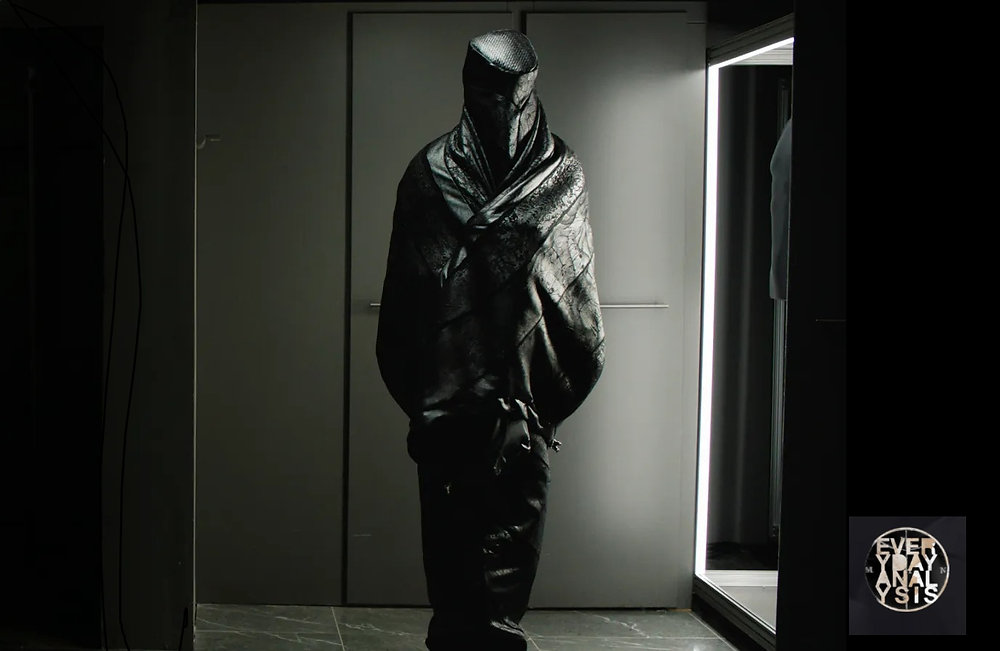
In the film, protagonist Karsh (Vincent Cassel)—starring as Cronenberg's alter-ego himself—loses his wife to cancer, and to cope with the loss he invents a wearable shroud (Shiny Cloth Technology) consisting of a series of internal cameras capable of constantly filming the corpse inside the coffin, and then constantly broadcasting the recording live on a device screen. Over the next four years, the shroud became the spearhead of a multinational entrepreneurial project, GraveTech, a system for digitizing cemeteries and "connecting" loved ones with the graves of the deceased.
In Karsh's atheistic, organic view, the body "is reality," after that there is nothing. This consideration leads the protagonist to chase his wife's body all the way into the coffin.
The invention of the shroud is not only to be read as a technical response designed to support Karsh's endurance of finitude and death, but also as an early form of disavowal of this very truth.
Although Karsh keeps repeating that the body is the limit and after that there is nothing, although he knows—as an atheist—that this is the underlying truth, the construction and fruition of the shroud is meant to recreate a bridge in which this truth falters and the desperate belief in an afterlife surfaces as a necessity.
The disappearance of Becca’s remains represents the failure of the material and rational attempt at disavowal, a moment of no return in which the construction of a coherent frame begins to crumble.
After four years, sexual desire reappears in the protagonist: symbolically and literally, Karsh begins to see and touch other bodies as well. The awakening of desire manifests itself as an entropic unconscious that complicates and develops the whole plot.
Reality overlays with recurring dreams that in turn become nightmares. Death escapes any process of positive resignification.
The last bastion is to construct a conspiracy theory—made up of doctors, secret agents, experimentation and political issues—in order to find a meaning that can work, following the failure of all other attempts.
Cronenberg himself notes how paranoia and conspiracy “goes with the grief.” When there is no meaning, we invent one.
The ending is consistent in its incoherence: Karsh wakes up on a plane with his new lover; we do not know whether he is still dreaming. The narrative metaphor closes in its inconclusive being.
Perhaps what makes us human is not only the creation of myths, narratives and beliefs to make sense of death, but rather the conflict that is established with it and the ultimate awareness of its meaninglessness.
Accepting the meaninglessness of death, in a world where perverse and cynical forms of disavowal resignify bodies and populations to justify the most heinous actions, is perhaps an act as human as it is urgent.
Christian Nirvana Damato (1994) is a writer, curator, and independent researcher working in the fields of philosophy, technology, psychoanalysis, and visual culture. He teaches media theory at the IED in Turin. He writes and collaborates with various magazines and publishing houses. He is the founder and editorial director of Inactual.